CLICK HERE FOR THOUSANDS OF FREE BLOGGER TEMPLATES »
Showing posts with label natural resources. Show all posts

Tuesday, April 12, 2011

Ethno-ornithology: Double-crested cormorants

Adult double-crested cormorant in non-breeding plumage. Photo information available here.


My good friend Flicker Boi has written several blogs about using lethal measures to reduce or remove populations of non-native birds from areas where they are in direct breeding, foraging or nesting competition with closely related species of threatened or endangered birds. Lethal methods of population control seems to be the most common form of control, likely because we are more familiar with this form of control. Eminant Domain says we should conquer, control and subdue nature (and the people that live close to it). Hunters relish the chance to kill coyotes, cougars, wolves and other "pests." This leads me to my current train of thought. Double-crested cormorants (Phalacrocorax auritus) are the most common species of North American cormorant (and darn cute). Their numbers are on the incline and thus they are the focus of blame for declines in sports fishing and for "devastating fish farms" (All About Birds, 2011). In 2003, true to our "lethal control" nature, a management plan was proposed by the United States Fish and Wildlife Service to use depredation to decrease the North American population of double-crested cormorants by <160,000 birds (U.S. Fish and Wildlife Service, 2003). Before I go any further let me just say that I'm not sure why managers are not allowed to use lethal measure to control populations of FERAL horses, cats, etc (not that I am advocating for the slaughter of these animals...though I do advocate RESPONSIBLE management) but it is encouraged in regards to NATIVE species (cougars, coyotes, cormorants, wolves, etc). My assumption is that horses and cats are charismatic/domestic species so we feel a stronger connection to them. Or maybe it's just Eminant Domain in another form.

The reasons listed in the approximately 140 page Environmental Impact Statement (EIS) for the creation of the management plan are: negative impacts on other bird species, declines in native fish populations (including threatened and endangered species of fish), destruction of vegetation at nesting sites, increasing economic losses to aquaculture producers and commercial fishers and fish-related businesses, a loss of private resources and loss of water quality. As internationally migrating, birds double-crested cormorants are protected under the Migratory Bird Treaty Act (MBTA). The MBTA does allow for migratory bird "take" permits so long as they follow regulations set forth by the MBTA. In fact, according to the U.S. Fish and Wildlife Service "permits to take DCCOs have been issued by the Service since 1986 and may allow the take of eggs, adults and young, or active nests.". Though apparently commercial interests don't always have to have a permit for depredation, if so deemed by the United States Government. According to the U.S. Fish and Wildlife Service:

"In 1998, the Service issued a depredation order (USFWS 1998b; 50 CFR 21.47 ) authorizing commercial freshwater aquaculture producers in 13 States (Alabama, Arkansas, Florida, Georgia, Kentucky, Louisiana, Minnesota, Mississippi, North Carolina, Oklahoma, South Carolina, Tennessee, and Texas) to take DCCOs, without a Federal permit, when found committing or about to commit depredations to aquaculture stocks. The depredation order states that DCCOs may be taken by shooting only during daylight hours, and only when necessary to protect freshwater commercial aquaculture and State-operated hatchery stocks and that such actions must be carried out in conjunction with a non-lethal harassment program certified by APHIS/WS officials."


This seems odd to me as permits keep track of the number of individuals being killed and would thus allow international governments to understand what we are doing here in the United States (and would help to ensure that there is international cooperation and agreement on managing population levels). As I read this EIS I am struck at how certain the individuals writing the EIS are that "taking" <160,000 cormorants won't hurt regional or continental populations. How do they know that wiping out entire winter roosts (as is permitted under this management plan) won't create genetic bottleneck? How can they be certain that the birds that are left won't be subjected to some disease that the birds that were killed wouldn't have been susceptible to? With what certainty can they say that Mexico, who according to the EIS has no management plan on record, and Canada, who has a status of no protection for the double-crested cormorant, aren't killing >160,000 and that at some point we will have to create a restoration plan (like they did in 1972 when DDT and lethal control lead to federal protection of double-crested cormorants)?

One of the more interesting parts of this EIS comes about in Chapter 3. Throughout the EIS Federally-recognized Tribes and Tribal hatcheries are listed as individuals that can practice lethal measure with double-crested cormorants (at hatcheries or aquaculture facilities). In chapter three tribes also fall under a section about Environmental Justice. That is all well and good but here we find a bit of a contradiction. Earlier in Chapter 3 the EIS mentions that in Oregon populations of double-creseted cormorants are on the decline (about 2.6% annually), other than at the Columbia River Estuary. Under the Environmental Justice section the writers mention the U.S. Fish and Wildlife Service's Responsibility to tribes to provide them with fish stock. In the next paragraph they mention "in Oregon, approximately 80 percent of all trout harvested come from Oregon fish hatcheries," implying that by not increasing the numbers of double-crested cormorants killed would create a system of environmental injustice to Oregon tribes (though I feel certain most tribes raise salmon here). This is despite the fact that double-crested cormorant populations are declining in Oregon. In yet another ironic, and contradictory, twist in the "Issues Raised, but Eliminated from Detailed Study" section the writers mention the fact that double-crested cormorants are considered sacred by some tribes and therefore this plan could directly conflict with their spiritual beliefs. The mention of their sacredness follows a mention of yet another issue rejected for study, "Affected Human Communities." In this section the writers mention the three letters they received from tribes or members of tribes. These letters were:

"(1) a member of the Kiowa Tribe of the State of Oklahoma felt that since waterbirds are sacred, they should be given to Tribal people for use in their native ceremonies; (2) the White Mountain Apache Tribe of Arizona recommended that we use a hunting season to manage DCCOs; and (3) a Conservation Officer from the Wampanoag Tribe of Gay Head (of southeastern Massachusetts) said that they have experienced some trouble with DCCOs roosting on the Tribal Shellfish Aquaculture Program’s spawning/rearing cages and recommended limited hunting."

There is also mention several times to double-crested cormorants adding to the "Spirit of Place" but this too falls under the issues not studies. If you'd like to read the quite lengthy EIS click here. The U.S. Fish and Wildlife Service has a double-crested cormorant faq sheet you can peruse and an informational page too. I found this USGS map from the Breeding Bird Survey (BBS) and this USGS map from the Christmas Bird Count (CBC) to be quite interesting. The entire USGS double-crested cormorant information page is accessible from either of those links, but just in case you can click here for the double-crested cormorant ID page.

While researching double-crested cormorant management plans I came across a blog written on March 29, 2011 about Oregon Department of Fish and Wildlife's (ODFW) application for a depredation permit. According to Jim Yuskavitch, ODFW intends to identify the areas where double-crested cormorants will be killed, likely areas where they are considered to be most likely to harm wild juvenile steelhead and salmon populations. Yuskavitch mentions the debate over lethal control of sea lions at Bonneville Dam and whether or not allowing the "take" of native predators of salmonids makes more sense than cultural controls that improve habitat quality and abundance and decreasing commercial fishing, among other things. I find it interesting that cormorants are protected by the MBTA and sea lions are protected by the Marine Mammal Protection Act and the wild (not hatchery) salmon (some of them) are listed as threatened or endangered by the Endangered Species Act. The common thread between all of these species? At some point in time we decimated, or nearly decimated, their populations, for one reason or another, and now they are all federally protected species. While reading the ODFW publication "Avian Predation Management on the Oregon Coast, " published March 25, 2010 I learned that Caspian tern's are also considered a threat to juvenile salmonids on out-migration (their journey to the sea). It is interesting to note that they don't seem to be considering lethal control at this time. Additionally both Caspian terns and double-crested cormorants seem to be considered a problem (with increasing population sizes) in one major area, the East Sand Island on the Lower Columbia River, an island created by the deposition of dredge spoils. So...WE are the cause of these population inclines of these species, just as we are the reason that sea lions find such fishing success at the Bonneville Dam fish ladder.

Our decisions or proposals or plans to kill native wildlife for taking advantage of the habitat that we have created and for acting as they should in the situation they are in is preposterous. Everything I have read tonight has pointed to humans as the main culprit (which I already knew/thought) and has me thinking (as many things do) about the fact that we live in a highly managed world. No matter where we are, no matter what we are doing we are in a managed area. What we see and what we experience, these things are all allowed to be, or altered, or removed from existence based upon their economic value, on our perception of aesthetic, or on our concept of worth. Tonight, for me, the battle that we face ahead as stewards of the land and of nature looms not in the distance, not on the horizon, but in my backyard. At my favorite birding places. At the places where I find the most solace. The fate of every species of this place (Earth) balances on the ability of someone, somewhere to give it value. We are seriously disrupting the balance of the systems that we live in, with. That we are part of. The continual separation of humans from nature. Intrinsic value versus extrinsic value. Economic value from natural/ecosystem value. These separations destroy the very things we claim to be trying to protect.


Wednesday, March 16, 2011

Ethno-ornithology Sunday: birdwatchers

I started this last Friday to have it posted Sunday. Then we had a HUGE storm (wind gusts at one hilltop weather station recorded at 70mph) come through and I was without power for a good 50+ hours.

Frog-o-rama
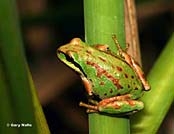
Image from the Northern Pacific Treefrog USGS fact sheet

I have never been much of a frog person. I mean, I like them, like what they do in the ecosystems they are found in, but they've never topped my "favorite animals"
chart. Being that it is almost spring and their circadian clocks are telling them it's time to make themselves known I've been giving them more notice than usual. Tonight, as I have for the last several nights, I listened to the chorus of frogs "singing" all around my home. Tonight they seem to have reached a more frantic, urgent rhythm. Their little croaks giving the night a different kind of pulse than it usually has. I drink in the sound, allow it to seep into my skin, my bones, my veins, until I can feel the rhythm playing out in my own being. If I were a frog I'm sure I'd be aroused by all of these boisterous males proclaiming their sexual prowess and genetic superiority. Sometimes, like the undulation of the ocean, their volume decreases until it is almost silent. Then their voices raise, in volume and in number until they are virtually shouting for attention and by force of sheer numbers their cacophony crashes around me, wave after wave of glorious little frogs "songs."

This, of course, makes me think of birds. Even males that procure a territory before they procure a mate sing of their own sexiness in order to attract a mate. In all honesty there are many, many ways that birds actually attract their mates but right now, be
cause of the frog song I'm thinking of male birds and their boisterous, glorious singing. One lonely marsh wren has the same affect on me as the scads of Northern Pacific treefrogs that are out singing right now. The wrens get to really singing and I feel like their song is all that matters, because in that moment it is all that matters. These little birds that sing, and sing, and sing, at risk of being discovered and consumed desperate to attract a mate. Marsh wrens, among many other species, create new songs in a constant effort to "one up" their neighbors. I rather enjoy walking along areas that have several wren territories in a row and listening to the increasing complexity of their songs. And that is just at the frequencies and decibles that I can hear, I'm sure that if I could hear like their intended audience I'd be even more exhilarated. Or I'd think they were unexciting and move on to find a more suitable male.

Bird songs, of course, make me think of birdwatchers. What self-respecting birder doesn't know at least a handful of songs with which to identify the birds they can hear but not see. More specifically, I am thinking about the waste we create in our continuing efforts to learn to identify birds or to add one (or 100) new birds to our life lists (which I don't keep and don't quite understand keeping). Books, cds, computer programs, binoculars, scopes, bird feeders and an ever expanding array of technological gadgets. I recently learned about applications, BirdJam being one of them that seems fairly popular (at least when I did my online search), for ipods and iphones that help identify birds. Mark at "Birds in Your Backyard" talks about tech-savvy birders and the inroads that technology is making into the birding world. While I understand the appeal of technology in birding (how many times would I have really appreciated a recording of a bird call when out birding) I just can't support increasing the amount of disposable, breakable and toxic material goods being produced, used and disposed of in this country every day. Now, that isn't to say that there aren't advantages to having technology in the field, home or office. And it isn't to say that there aren't ways of making technology less harmful (borrowing cds from the library or buying bird guides as mp3's to forgo shipping and packaging for example). I just think that it is our responsibility, as consumers of nature, as "collectors" of birds, to protect them and the land that they (and we) depend on. If the ultimate goal is to know more birds, by sight and by ear, than anyone else. If the goal of finding birds is to outcompete, out ID, out do every other birder/birding competitor how much better are we than the people that raced against each other and time to kill ivory-billed woodpeckers for their collections/collectors. We may not be directly killing them, but maybe slowly killing them through habitat destruction, introduction of invasive species, nesting disturbance and by polluting their homes is worse. Maybe we too are loving birds to death. To extinction. To finality. Maybe it is time to get back to basics. To live, and bird, simply. To realize that if our presence in an area is threatening a species…maybe we don't need to add them to our life lists. I know for me, birding is best done with (at most) a pair of binoculars, a bird book and my own curiosity. Oh, and sometimes a little help from the Cornell Laboratory of Ornithology All About Birds guide when I have a bird song stuck in my head that I can't seem to identify.

*When you click on the All About Birds link you will be directed to their page about brown creepers. This is because these little guys have a delightfully melodious song that "plagued" me about two springs ago. I'd walk around singing the song in my head trying to pair it with the birds that I knew would be here. Then, one day when the song was filling the air around me, I saw a brown creeper in one of the ponderosa pines near my house. I immediately ran up to the house, logged onto All About Birds, looked up the brown creeper and discovered that this often shy and seemingly quiet nuthatch-like (the reason I had skimmed over them originally) birds, are really quite wonderful singers.


Tuesday, September 16, 2008

"No Impact Man"

Colin Beavan of NYC started a project in August or September 2006, to try and create no net impact on the environment. He had apparently decided to "walk the talk." So, I've been reading his blog for easily an hour now. At first I was put off. He's making a book and a movie about this journey, both require a lot of energy and resources to create. So, I looked into the book and movie more. Okay, he says the publishers will be using sustainable materials. Good. The movie is a documentary, cameras follow him and his wife around. Seems better than a post journey movie deal. BUT . . . what kind of sustainable materials? Are we talking recycled paper? Good, what percent post-consumer? 20% . . . 50% . . . 80% . . . 100%? In order to appear as unhypocritical as possible it'll have to be 80-100%. I mean if Seventh Generation can make almost entirely post-consumer toilet paper, you can make a book the same way. Will the paper be bleached? Again unbleached paper will create a less negative impact, it'd look cooler too. Ultimately, creating more "stuff" for consumers seems the opposite of what you'd want to do to encourage "no net impact."

After reading his blog for a while though I realized something. First, even though this guy is a megalomaniac he cops to it. Excellent. Second, he seems to be genuinely inspiring people, both to hate him and to try and follow his lead. Anyone who inspires right-wingers to hate them is probably alright with me. Third, whatever . . . at least he's making an effort. We can't all be as saintly as we'd like to be all the time.

This leads me to divulge some of my own flubs. My family lives three hours away. For a while there we were visiting them once a month. Even though I get 25 mpg most of the time it is still a LOT of gas. I rescued a horse. Plus one karma point (maybe more since I am nigh onto broke and she's EXPENSIVE) for me, minus one crunchy point because of the resources she requires (hay, grain, etc). I have two dogs. They were rescues too, so again plus karma points, but they burn up resources, minus crunchy points. What are we attempting in order to decrease our impact? Less trips home. I love little Audrey and enjoy my time with my family but it's a long drive and I feel guilty every time I make it. Huka lives in a pasture and her manure becomes fertilizer and we buy local hay and grain. For the dogs we buy "bio bags," biodegradable poop bags. We also recently bought a second hand (smells like bulk salsa once lived in it) 5 gallon bucket from the co-op. Bulk dog food now inhabits the bucket. It costs less and we don't have a giant bag to throw away at the end of the month anymore. I wish the meat center at OSU had non-basted bones so we could buy "chewies" without packaging.

Furthermore that new computer I want, so that we don't have to juggle computers at home, probably shouldn't happen. Ouch. Three people in college, two with on-line classes, one with two college classes to teach. Hmmm . . . for someone living increasingly sustainably sustainability can still be hard!

I've switched to cloth pads for my feminine woes. I know that this is something we're encouraged not to talk about publicly but I can't help it. Us ladies create a lot of waste with our disposable products, even the environmentally friendly ones still end up in sewers or landfills. So, here it is . . . This was the first month and there are a few kinks that need to be worked out. Namely ensuring that I don't use/waste more water by using them. Speaking of garbage . . . we've started using garbage bags only in the bathroom (as long as there are disposable lady products there will be a liner). The garbage bags we do use are also "bio bags." For all other garbage we have a five gallon bucket that we just dump garbage into. We're down to only about a gallon of garbage per week for three people and two dogs. Not bad. Once a month I rinse the bucket with a vinegar solution so it stays "clean."

Now if we can just figure out how to get the three of us places without driving at all. The bus system here is great, but from our apartment only goes one place we need it to, OSU. *Sigh* this is a process!

Wednesday, August 20, 2008

Zoo

Nothing makes me revel in my natural resources degree and question my grad school future more than: stupidity, cool sustainability displays, stupidity, conservation, and stupidity. Yes, I mentioned stupidity three times. Why? Well, because stupid people make me glad I have a multi-faceted degree! I can explain and understand natural resources from a economic commodity angle, from the social side, from a politics and policy podium, and finally as a scientist. Whoever decided interdisciplinary degrees shouldn't get funding is stupid, those of in them rock! I have digressed from my intent here. At the zoo yesterday, yes I said zoo, there were a number of exhibits, signs and pamphlets about sustainability. The zoo itself has recycling bins with every trash can, they're working on ways to make their aquatic exhibits sustainable by creating recycling water systems and they have two exhibits regarding sustainability! One of the sustainability exhibits is sponsored by Trillium Creek Family Farms. This display has raised beds with a variety of produce growing in them, runner ducks, rabbits, pygora goats (I believe pygmy and angora crosses), Icelandic sheep (I want some of these!), chickens and a variety of displays regarding organic food, small farms, and things of this nature. The other display is actually a coalescing of small markers with backyard wildlife habitat types that are spread throughout the zoo. These markers lead to one area, a backyard wildlife habitat display! It is quite possibly one of my favorite zoo displays of all time! The Pacific Northwest region was my other favorite. What can I say? I am a sucker for animals found in my region. Yeah tigers, sun bears and lorikeets are amazing . . . but give me ringtails, black bears, salmon, bobcats and cougars any day. We have a lot of fabulous wildlife here in North America and people seem to sometimes forget that. Julie asked if there are breeding programs for non-charismatic birds that are going extinct (like the programs we had for bald eagles). Sadly, last time I checked there were none. It has been about five years, so I could be wrong, but that is the unfortunate part of being a non-charismatic species. People don't think about you, don't want to buy you and you aren't fantastic, you're just there. Where does this leave me? Believing that backyard wildlife habitat and preservation are my future. Maybe a zoo or wildlife rehabilitation center really are where I'll end up. North American wildlife, urban sustainability, and education? That's right up my alley!

While I'm at it . . . there is a VERY large difference between conservation and preservation folks! I grow tired of reading "environmental" slogans that use conservation to mean preservation. We saw a shirt at whole foods the other day that says "conservation is the key." Now, I agree that conservation is good, but if you ask the schmuck that'll be wearing that shirt what that means and they'll give you an explanation of preservation. Gifford Pinchot was a conservationist, John Muir was a preservationist. Conservation is maintaining something for future use (ie, making sure we have timber for future use). Preservation is maintaining something for future NATURE and WILDLIFE (ie, making sure wildlife will have a home, LEAVING the timber there, not touching it). When you say you're a conservationist you mean I want this to be here for the future but in a anthropogenic way. Preservation is ecocentric, conservation is anthropogenic. Preservation = nature. Conservation = people. Does this make sense?

Finally, back on the stupidity front because this needs to be said. At the zoo yesterday there was a family of "rednecks" in front of us through most of the PNW exhibit. These are the kind of people that go to zoos to enjoy the fact that we've put these animals behind bars, mans dominion over nature so to speak. While looking at the bobcats (one of my favorite NW predators) this girl says "We have one of those at home" Now I figure she means either in the woods near her home or maybe they have a permit to have one as a pet, or even that she's mistaken. After several attempts at getting a rise out of people with this line she gives up, stating "Well, a dead one anyway" Later, at the spotted owl (whom they tried to blind with their flash, breaking zoo policy) the father stated "hey we have a dead one of these at home too" (insert redneck, local yokel laugh). What is wrong with these people?! meh . . .