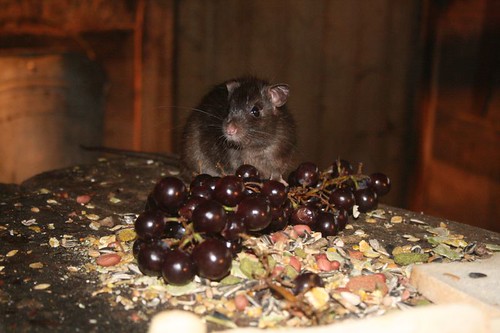
Well, I've slacked this week! I have been busy trying to get data entry done, thus my animal of the week post (started last week with rats) has been placed aside. Therefore, this is what I've got . . . it's not as in depth as I'd like to have explored, but it's what I had time for!
 A picture of the baby western gray squirrel and pine squirrel eating together on our patio.
 The baby gray squirrel. Can you see it's big feet? So cute!
 Douglas squirrel, my favorite!
This week I’ll be discussing squirrels. Originally I was going to discuss turtles, but the baby western gray squirrel that has been visiting us lately has changed my mind! The gray squirrel has arrived on the tail of one or more pine squirrels. Thankfully, it has avoided the feeders and stuck to the ground, cleaning up the seeds that our overzealous and picky red-breasted nuthatch visitor throws out. Typically the gray squirrels also chase out the smaller pine squirrels, this one eats with the pine squirrels, as long as they don’t get too close, probably because it is young. When I say young, I mean young. This little one still has over-large paws, baby fuzz and the more rounded heads common to young squirrels.
Classification of the squirrel: Kingdom-Animalia; Phylum-Chordata; Class-Mammalia; Order-Rodentia; Family-Sciuridae; Genus-Sciurus; western gray squirrel Species-griseus .
Geographic range of the western gray squirrel: Washington, Oregon, California and a small portion of Nevada.
Habitat: woodlands and coniferous forests; elevations of up to 2500 meters (from University of Michigan Animal Diversity Web).
Squirrels in Oregon: The major species of squirrels common to Oregon are the Douglas squirrel (we used to call them pine squirrels when I was a kid), western gray squirrel, California ground squirrel and northern flying squirrel. While the dominant species used to the be the Douglas squirrel and western gray squirrel the invasion of eastern gray squirrels and fox squirrels, combined with the loss of habitat to development, has lead to a steep decline in western gray squirrel populations. In Oregon the western gray squirrel is now listed as a species of concern, in Washington it is listed as threatened. This may seem unimportant, squirrels generally all perform the same ecological function. In fact the eastern gray squirrel has virtually replaced the western gray squirrel throughout the Pacific Northwest. Currently urban gray squirrels are typically eastern, while "woodland squirrels" are typically western.
Characteristics: “The western gray squirrel is the largest tree squirrel in Oregon. They are silvery gray, with a white belly. White tips on their gray hairs give them a silvery appearance. They have a bushy, silvery gray tail with black hairs. Adults weigh between 18 to 33 ounces. They can be as long as two feet, including their tail. They have tough, curved claws and strong legs for tree climbing and leaping” (Carol Savonen). Eastern gray squirrels have a reddish tint in the summer, are smaller and more aggressive than their western counterparts. Either way gray squirrels play an important ecological function in that 100s of the 1000 or so nuts and seeds they cache are forgotten and grow into trees and plants the following year.
Mythology/Spirituality: According to Ted Andrews squirrels serve as a “strong reminder we are on the right track, laying the foundation, and making the right preparations to enable us to succeed and prosper in the future” (from the Animal Wise Tarot by Ted Andrews). So, if a squirrel appears in your life you’re on the right track, or at least it seems like that is what he’s saying. Maybe it’s a good thing we have squirrels visiting us on a regular basis. In Norse mythology Ratatoskr is a red squirrel that delivers messages up and down the world tree, Yggdrasill. This squirrel was also a messenger for Odin, bringing him news from the human world.
When we'd get in litters of squirrels at wildlife images there were usually at least three babies. According to Sara Crane (University of Michigan) there are usually 3-5 babies, with older females giving birth to larger litters than young females. Females are able to reproduce by the time they're 11 mo old with a gestation of only 44 days and a weaning time of about 10 weeks (they're slow developers!). This probably explains why there are so many baby squirrels out and about in the summer, all females born in one year are capable of bearing young the following year! Squirrel nests are generally large and occur either in trees or external to them, made of sticks and moss. Gray squirrels are also diurnal, presumably because they are quick on their feet, thus being able to easier avoid predators.
For more information on western gray squirrels in Oregon I'd suggest going here. For more information on the squirrels of Washington go here. The information I've used was obtained from the following links, the photos are from our patio.
http://www.backyardnature.net/squrrls.htm
http://extension.oregonstate.edu/news/story.php?S_No=834&storyType=garden
http://www.squirrelsanctuary.org/curios.htm
http://animaldiversity.ummz.umich.edu/site/accounts/information/Sciurus_griseus.html
http://www.audubonportland.org/images/wcc_images/living%20with%20urban%20squirrels.pdf